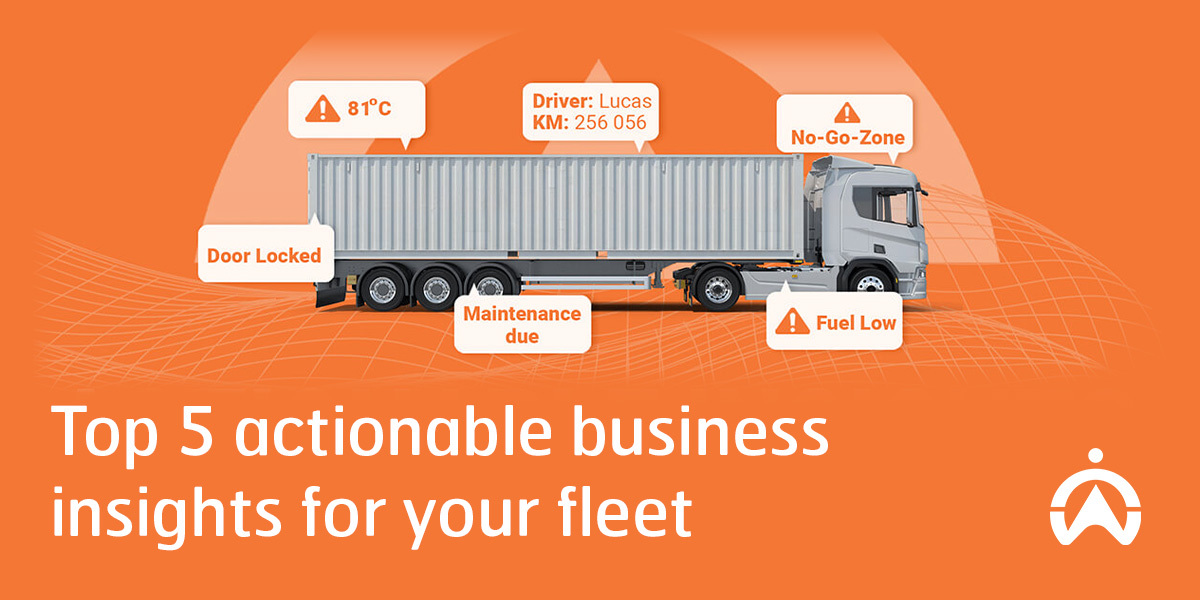
5 top actionable business insights for your fleet

The process of data collection is more than meets the eye. When cracked right, there are multiple ways businesses can use it to their advantage. It starts with analysis, followed by objective-based interpretation, and ends with opportunities for business development and exploration.
In this article, we’ll take you on an insightful data mission, where you will get the chance to achieve actionable business insights through data. We are here to empower managers and unleash their decision-making powers. 

Actionable business insights through data

How-fleet-management-helps-with-your-vehicle-maintenance

The data process can seem like quite a mouthful, but let’s break it up into bite sizes. |

Data: The information that you collect from your systems. For example, in the fleet management process, you might need data about driver behaviour, fuel consumption, maintenance alerts, and much more. 

Insights: The value you derive from the analysed data. You can use data analytics to identify trends and patterns in the information retrieved. Analytics assists to make sense of the data. 

Information: A product of refining this data and giving it structure and context. This way, you aren’t staring at a bunch of random numbers on spreadsheets and documents. 

Actionable insights: Are where the magic happens. This is the part where businesses use data analytics and discoveries to take action and improve the efficiency of their operations.
‍

There are many online tools available to make sense of data. In the fleet vehicle tracking industry, software platforms are trending. The advanced tech is already in place, with powerful insights, and integrated analytics – all designed to give you the reports you need.

 Let’s dive in a bit more.

What are actionable insights examples? 

How-Cartracks-fleet-management-delivers-actionable-insights

Fleet management systems or platforms are what fleet managers can use to achieve and harness actionable insights.  

These are accompanied by advanced software technology assisting businesses in developing a strategy to make informed decisions. 

You could choose Cartrack as a provider and gain actionable insights such as:  

  • Instantly pinpoint challenges. This will allow you to make changes immediately during work hours and in your business overall. While you are quickly putting fires out the business can keep growing with increased productivity levels.
  • Receive contextualised metrics. Perhaps you want a specific context for a certain reporting requirement, such as the cost per job. The operational, administrative, and financial data costs can be aligned for you to analyse this spec. Receive metrics for all three and can determine the exact cost per job, and make price comparisons. Maybe one outweighs the other creating a cost imbalance, so you might need to make some cost changes there. Also, compare accurate metrics to see whether your routes are optimal and know how other costs impact your margins.
  • Use comparable metrics. Compare metrics across drivers and vehicles to pinpoint price differences in costs per task, or differences in behaviour and maintenance costs for the vehicles they are driving. If one driver’s vehicle is costing significantly more on maintenance than others, managers can assist their driving behaviours and empower them where needed. Use this to assess driver productivity. Know how much time your drivers spend on the road and how many jobs they complete in the required time.
  • Get important insights instantly. There might be an urgent concern that needs your immediate attention, prompting a meeting with concerned parties. Say you don’t have time to spend hours analysing data; the platform will give you a visual overview of your fleet’s fuel consumption, unproductive idling, safety, and utilisation on the dashboard, all with one click. You can filter data by time or vehicle for added flexibility and speed in pinpointing challenges. With this, you can be prepared for your meeting without doing much prep.

What are data insights for business decisions? 

Data-insights-deliverd-through-cartarcks-fleet-management

We know that actionable data can help you make immediate moves and business decisions.  

 However, we should expand on it, ultimately using it in the best way possible for the business. In other words, use it to drive workforce optimisation, which encompasses admin together with task, team, and change management. 

 Fleet owners need a solid business structure and strategy behind them to set the foundation for fleet managers, drivers, and all other staff. From there, we can create meaning out of insights. 

 But let’s start with the base first.

Actionable insight business considerations

  • Get the right people in your corner

It’s important to hire the appropriate people for the job who can understand the data insights. Investing time and energy into finding the wrong people is costly, and not just financially, but for the business flow. For example, fleet managers should be hired based on the fleet experience they have to understand what the system data means. 
‍

  • Communication and team planning

The importance of communication and planning for businesses and teams has proven to be one of the most important task management strategies. With a vehicle fleet, it goes without saying that you will have a diverse team, often distributed all over. As a result, you need to plan, manage, follow up on tasks and create a space for them to excel. One way of doing this is having communication channels in place to improve driver productivity and ensure efficiency. Fleet software apps offer this feature. 
‍

  • Set up KPIs

These are used to assess an organisation’s performance against its goals. They aid in decision-making, assist in setting strategic objectives, and enable effective processes. This will motivate employees and assist with their performance. 
‍

  • Internal actions

Managers and teams need to create actions within their task management, and delegate tasks to team members. Reminders are set and updates are done, once the task is complete – they can move on to the next. This is also part of the communication channel chosen.
‍

  • Competitive advantage 

Companies should capture, manage and analyse their data to improve their business intelligence. They can then grab the opportunity to jump ahead of competitors by offering great customer service.

How do you convert data into meaningful insights?

Actionable-insights-brought-to-you-through-our-fleet-management-system
  1. Define your goals and objectives 

Before even choosing appropriate fleet management software, goals should be top of mind. Goals give everyday tasks more meaning and clarify the reasoning behind company decisions. Without these in place, there isn’t much to work towards causing stagnation and struggle to make accomplishments. Goals are steps to the end result, which are part of every business plan. 

Fleet managers can set operational goals such as saving on fuel costs and improving driver engagement. With this in mind, they can go directly to the part of the platform that gives this insight. Maybe the marketing team’s goal is to bring in more leads for the business, which will require a higher budget. Saving on fuel costs and working towards that goal, will directly bring in more revenue for the company. 

If this does come to fruition, the data indeed will be a meaningful insight that can be measured to the goals.

Now, you will be able to ask the right questions and figure out what questions you want your data to answer. Before you unravel the data, it will ensure that you don’t spend time on the wrong things.  
‍

  1. Segment your data 

Cutting up data into segments can help you make better sense of it. A fleet software platform works in the same way as Google Analytics. You can customise the platform to suit your needs, and pull up the specific data you require for adequate reporting. For example, maybe you have a management meeting about driver behaviour and productivity. You can create a segmentation for that on the platform, and then relay feedback on that only. 
‍

  1. Use visuals to simplify data sets

Visuals are a nice way to represent data in an easily comprehensible manner. Especially when it comes to presentations, you cannot use raw data to relay information, but should rather use visuals to show your findings. The software’s report function will be the starting point before you create the perfect presentation for your meeting. 
‍

  1. Discover the context

Without the right context, you’re either not getting the full story or getting the wrong one. Based on your pre-determined goals, you need to get the full picture to create meaning out of the outcome or visuals. You should ask questions like who is responsible for this within your fleet? Or why did it happen? And in what way does it affect the business?
‍

  1. Spot the right patterns

Up, down and zig-zags in between, this is what you commonly see on visual representations. From this, you can determine patterns or trends in the data concerning certain incidents. You can identify when there is an upward or downward trend, visualise a relationship between two factors, and more. They’re all tailored towards uncovering the stories behind the data. 
‍

  1. Determine a hypothesis and action plan

You’ve done your research, now is the time to get going with an action plan. Perhaps, vehicle maintenance issues are the common trend of driver misconduct. Maybe you need to delegate this issue to more team members to resolve, where they will dissect this reporting feature in more detail. 

6 key attributes of an actionable insight

Actionable-insights-for-your-business-through-our-fleet-management

We understand that you could be on the move a lot. Want a quick rundown of how to achieve actionable insights? Whip these out and take action.

  1. Alignment

Tie your insights to defined business goals to drive action. Align them with your KPIs to create urgency.

  1. Context

You need background information or comparisons to give data insightful context. Otherwise, there will be more unanswered questions rather than a plan.

  1. Relevance

Deliver the insight to the right person at the right time and setting. They need to reach key decision-makers for appropriate action to take place.

  1. Specificity

If you are highlighting actions, then you need to explain them in detail for people to understand. Explain why something happened to develop more action.

  1. Novelty

Give interesting insights. There’s no need for repetitive insights but rather to give new developments to create more growth and challenges. We switch off to information if we feel they constantly reinforce, rather than challenge and increase our current knowledge.

  1. Clarity 

Insights need to be clear to understand. People need to understand the reason behind it and how it will help them. Visualisations will help the information stick.

Conclusion 

Need some meaningful insights? With Cartrack, there are hundreds of reports to boost your business. Speak to us today and receive automated reports to match your workflow straight in your inbox. 
Easy steps for fleet managers to improve employee productivity

Managing fleet administrative tasks such as vehicle registration, fuel cards, invoicing and much more, leaves little to no time for fleet managers to focus on other business matters such as –  employee productivity. Here’s how fleet managers can improve productivity rates.

Fleet managers often wear multiple hats and work on several projects simultaneously. Managing fleet administrative tasks such as vehicle registration, fuel cards, invoicing, driver expenses and quoting leaves little to no time to focus on other critical business matters, such as – employee productivity. Learn how to boost staff productivity and encourage fleet managers to bring production back on track. 

With all the responsibilities fleet managers have, some might not be aware of the modern fleet technologies out there that can lessen their load and prove helpful in their daily duties. The most efficient way for fleet managers to increase their employee productivity is by outsourcing some of their responsibilities to someone, or something else. 

Telematics and fleet management systems

A fleet management system is a database used to store all records of your fleet. Documentation on active vehicles, fleet vehicle specs, maintenance and anything else that has to do with your fleet vehicles can all be stored and accessed anytime you need the information. 

Telematics, on the other hand, is a combination of vehicle tracking and communication services. It gathers and analyses all data collected from your vehicle(s) and sends it directly to the fleet manager. This information is used to keep track of various vehicle information.

Together, they possess a wide range of fleet data, reports and insights that fleet managers have full access to. All the administrative tasks that would have taken the manager several days to gather and compile, would all be waiting for him/her as soon as they open their laptop or phone. 

How does fleet management help improve employee productivity?‍

The role of fleet managers is to keep costs low, maximise profits, and minimise risk while overseeing a fleet. With fleet management systems and telematics, half of the hard work would already be taken care of.

With the help of GPS technology, fleet management systems allow you to: 

• Know the location of every vehicle in your fleet

• Be aware of each vehicle’s fuel consumption and be able to save

• Be able to decrease maintenance costs by continuously monitoring the vehicles

• Being the first to know when something needs to be replaced or fixed

• Cut delivery time down by implementing route optimisation 

With these benefits put in place, and fleet management systems handling the heavy-duty tasks, fleet managers have more time to focus on maximising safety, improving service delivery standards and customer service and satisfaction. Fleet management systems don’t only improve a business’s work efficiency they also positively affect every employee’s productivity. 

What is Employee Productivity?

Employee productivity is about fleet managers working smarter to raise the business’s bottom line. It’s the amount of work an employee gets done in a specific amount of time, or in simpler terms, how many jobs a fleet driver completes in a day. 

Managers can access fleet data or employee productivity reports through productivity tracking and see where the majority of the employees’ time goes, how long it takes to complete their work and the quality in which it is done. This information is used by the manager to optimise operations going forward.

Productivity tracking

Productivity tracking measures show how productive your employees are in terms of how many projects they can handle and how fast they can get them done. It also tracks what the employees do when they are idling or simply not working, which websites they visit and how long they spend on these sites.

For a fleet manager, overseeing their many tasks on a day-to-day basis and being able to complete them before the day is done is very important. Productivity rates could rapidly decrease if their process is decreased by employees idling by or not completing their quota of tasks. It’s the manager’s job to keep them on schedule and avoid disaster.

“We often assume that productivity means getting more things done each day. Wrong. Productivity is getting important things done consistently,” says James Clear, author of Atomic Habits, “and no matter what you are working on, there are only a few things that are truly important. Being productive is about maintaining a steady, average speed on a few things, not maximum speed on everything,” says the productivity expert.

James Clear shares some top productivity methods with us: 

These productivity methods could be used and utilised by both managers and employees. A valuable tool to have in your workflow management arsenal.

  1. Eliminate Time-Wasting Activities by Using the Eisenhower Box

The Eisenhower box is a task management tool that helps you prioritise tasks. It helps distinguish tasks according to urgency and importance and then lets you go through your work accordingly.

  1. Warren Buffett’s “ 2 List ” Strategy

Warren Buffett, a well-known billionaire investor, devised a two-list strategy in which you write 25 of your top priorities on one list, circle five goals from the first list, and jot them down on the second. Then only focus on those five while avoiding the remaining 20. 

  1. The Ivy Lee Method

This is a 100-year-old strategy that’s proven to work time and time again. At the end of each day, write down six important tasks for the next day, then immediately do those tasks first thing in the morning. Repeat each working day with a new list.

  1. The 15-Minute, Anthony Trollope method

Anthony Trollope created a routine where he would ruthlessly do his work at 15-minute intervals every morning without giving himself any leeway. He exceeded his goals and increased productivity by: 

  • Having someone keep him accountable
  • Tracking his progress
  • Focusing on the small achievements, not the finished product

Being productive is as simple as taking a few minutes out of your day and implementing one of these methods. Ten minutes of planning could result in a whole day’s worth of productive work.

What does it mean to improve employee productivity?‍

Increasing your employees’ productivity means catering to their needs. Fleet managers do this by:

  • Creating a healthy work-life balance
  • Establishing employee relationships within the workforce
  • Creating doable working hours
  • Providing positive feedback on how they can improve their work. 

This allows fleet managers to make long-term solutions that will encourage employee productivity in the long run. These suggestions might not have immediate results, but little by little, an improvement will be evident in productivity rates.

5 Ways to boost employee productivity in your workplace‍

For employees, it’s easy to fall into the mundane routine of working at a steady pace, which often results in incomplete tasks. This could add more tasks to your to-do list for the following day. The more you repeat this cycle, the more work gets piled up and results in procrastination, falling behind on work and slowing down efficiency in your respective department.

Being productive is a skill that many of us struggle to grasp, but it does not have to be that way. Here are a few tips managers should implement to help increase their employees’ productivity at work.

  1. Stop multitasking

You might think doing a few tasks at once will help you finish your work faster, but in truth, it only slows you down and creates more work, as seen in the scenario above. Giving your attention to one task at a time is the only way to ensure your work is done and done properly.

  1. Take breaks

The time allocated for your break is important. It gives your mind and body time to recuperate and get some much-needed energy back into your system. One might think working for a prolonged period means being productive, but the opposite is true. You will feel mentally drained and produce work of poorer quality at a slower rate if you don’t take some time for yourself. 

  1. Set small goals

Small achievements help maintain momentum over the long run. You’re more likely to complete large projects when they come by focusing on every achievement, no matter how big or small. 

Acknowledging employees’ achievements helps motivate them, which in turn makes them more productive.  

  1. Do the most work when you have the most energy

Whether it’s in the early hours of the work-day, or right after your lunch break, the time of day when you’re most alert and energised should be the time where you attend to your biggest tasks. Big projects require large amounts of energy, so give them the proper amount of time and attention they need. There’s no use letting all that energy go to waste on follow-up emails and organising paperwork.

  1. Implement the “two-minute rule”

This method is perfect for preventing procrastination and for reaching objectives without even noticing. All you have to do is fill small spaces of idling by doing tasks that would take you two minutes to do. Before you know it, you will have accomplished a lot of work and improved your work ethic.

Factors that impact employee productivity‍

Investing in your employees will have a lasting impact on your organisation. Beyond an employee’s experience, skills, and work ethic, several other office-based factors affect their work. These factors impact employee productivity, but they are often overlooked by fleet managers:

  • Engagement: Managers often think employees are productive simply by waking up, showing up for work and doing their assigned tasks. Getting to know your employees, giving them a sense of value and purpose so they feel a need to want to do more, is also an important aspect. It encourages them to be more productive.
  • Management practices: What level of engagement does the fleet manager have? Are they available and easily approachable by employees? And does he or she work with individuals’ strengths? Are they able to motivate their workers through their management style? These questions help determine if a manager’s management practice is effective or if it’s a liability to the business.
  • Workplace environment: When the atmosphere is unpleasant or intense, engagement and productivity levels plummet, which negatively affects the entire organisation’s productivity. Unnecessary stress and pressure might even drive employees to consider working for other businesses. 

Fleet managers should look for ways to lighten the mood in stressful moments to ensure their employees remain calm and focused.

  • Appropriate tools: It is about providing people with the necessary tools and resources they need to get their jobs done to the best of their abilities. As a manager, make sure systems are in place to ensure new employee hires and current staff members have access to all the necessary software and resources they need to get their jobs done. 

Employee engagement‍

This can be seen as the level of involvement or interest employees have within their workspace, towards their managers and with their surrounding colleagues. Whether they are fully involved in the business culture or are struggling to integrate into the environment. 

Prioritising employee engagement in the business and various departments within it will build up work relationships and help in the long run, by making employees feel welcomed and more comfortable at work. Providing a safe environment for stellar production increases is an investment any business should be willing to make.

Lack of employee engagement‍

This lack of interest is often a result of improper organisational socialisation, also known as onboarding, in the first few weeks of the company. This is usually the responsibility of HR and the training department, but fleet managers also have a role in continuing to inform, assist and guide employees in their new roles and duties. This will aid in employees’ getting to know and engaging with their environment, colleagues and managers.

The type of work produced by an employee who is merely there to clock in and finish off their day, and one produced by an employee who truly enjoys their work and interacts with their colleagues, are drastically different.

Based on research gathered from 50 employees, Gallup states that “ Engaged employees produce better business outcomes than other employees – across industry, company size and nationality, and in good economic times and bad.”

Key factors to staff engagement:‍

  1. Purpose – “ People want purpose and meaning from their work. They want to be known for what makes them unique. This is what drives employee engagement.” says Gallup.
  1. Development – Employees need to feel like their skills and know-how are constantly being improved and they are learning new things by being at work. Not a place where they constantly share their business knowledge, but one where the business gives back by investing in them. 
  1. A caring manager – Some managers think they need to lead with an iron fist, but a friendly personality and positive feedback go a long way.
  1. Ongoing conversations – The relationship between an employee and their supervisor is critical. If the employee and manager have a good line of communication with each other, issues can be resolved quickly and the work produced will be more aligned with the manager’s expectations, which means fewer reverts.  
  1. A focus on strengths – Employees must focus on the strengths they already have while cultivating and improving their weaknesses. 
  1. Have team building activities – Most people might think this is the job of HR, but managers are the ones that have to put the effort into planning and implementing team building activities as they have an impact on the overall production and behaviour of their employees.
An image of a truck moving at high speed on the road

Project management‍

Project management is a process that helps to identify and manage the scope, cost, schedule, risks, and resources of a business. It also includes making sure that all the employees’ tasks are completed, resources are allocated appropriately, and that the work produced provides the business with increased sales and meets the business’s objectives. 

The goal of project management is to create an environment where everyone on the team can work together and produce their best work. The aim is not to fix short-term problems like increasing the number of customer calls or emails sent per day. Yes, these are factors that increase employee productivity, but these problems will more than likely not have an impact on productivity in the long run.

What are performance measures‍

Performance measures are a collection of different attributes that come together to show how much a business, or employee, has achieved, based on its performance in a specific amount of time.

Many businesses use performance measures to set goals established by what their stakeholders and higher-ups expect from them. They then push these objectives towards their fleet managers and employees, to have a set goal.

Understand performance pace for different employees‍

Remember, not all employees work the same or at the same pace. For fleet managers, comparing one employee’s performance to their overall expectations of them or even to another employee is not always an accurate indicator of their ability to perform. 

Managers have to evaluate each employee individually. Keep in mind that they are not all on the same level and they each have their own strengths, weaknesses and process they follow to get through their work. 

Use employee productivity reports to customise every evaluation and use that data to individually improve productivity output. This will improve confidence in the employer, as it shows that the performance measures taken are used to help employees identify their ‘blind spots’. It also builds trust as it proves that the software is really there to make improvements and not as a spy tool.

The importance of performance measures‍

These are to keep fleet managers and businesses accountable and informed about every step taken to reach their goals. Each performance improvement is used to track the trajectory to success and the period in which it would take them to reach their target. 

Without performance measures, managers wouldn’t have any means of tracking small milestones made on their way to achieving the business’s objectives.

Here are five pros and cons regarding productivity monitoring and performance measures:

Advantages ‍

  • Ensures fairness within a work environment
  • Track individuals and team productivity
  • Sets positive standards for workplace behaviour, even outside the office
  • It reveals high-performing employers and underperformers
  • Shields business from cyberattacks

Disadvantages‍

  • Distributions of trust
  • Creates privacy problems
  • Employees can feel highly monitored and start to feel uncomfortable doing their job.
  • Lack of knowledge concerning the monitoring software
  • Cannot track where online, the employee spends their time

Most of the disadvantages of productivity monitoring can be dealt with through effective communication, indicating what exactly will be monitored.

For fleet managers, it’s important to be open and inform fleet drivers of the necessary safety measures put in place in each vehicle, yes, including the AI camera system recording their every move.

Advantages of employee productivity tracking

Productivity tracking helps to fine-tune business efficiency and employee work ethic. It helps the business in the long run by focusing on long-term solutions and not just short-term ones. 

With the help of productivity tracking software, fleet managers can change the way they monitor employees, measure time, and keep track of their teams in between formal office hours.

Here are some of the benefits of implementing employee productivity:

  • Improve employee productivity and efficiency
  • Identifies struggles and internal problems
  • Efficiently track attendance and effort
  • Improves working from home conditions
  • Creates trust in employees
  • Effective project management
  • Increases security and safety

Employee productivity monitoring analyses the data provided to improve your employee’s work ethic, behaviour and productivity.

It is designed to show fleet managers which measures work. The data can be used to improve a team’s productivity as well as allow fleet managers to make informed important decisions like:

  • Whether they need to adjust their goals 
  • Modifying certain departments. 

It also gives a business a good indication of how far they are from achieving their objectives.

Make Cartrack your no.1 solution‍

When looking for a digital assistant to help you improve your employee productivity ratings, workflow and work ethic, Cartrack’s fleet management solutions do it all. 

Cartrack offers fleet managers a range of add-on features that help cut fuel costs and driver expenses, lowers acquisition prices, saving businesses time and money. 

Some add-on features include: 

  • Routing
  • Fuel Monitoring
  • Temperature monitoring 
  • CarWatch

Take your first step into work optimisation, contact us today to get a quote.

How to Maintain Your Car

At Cartrack, we are fully aware of just how important it is to protect your car. That’s why we give you peace of mind when it comes to its security. However, protecting your car from thieves doesn’t mean much if you don’t take good care of it, as your vehicle will soon become undrivable

It is critical to regularly maintain your car and send it for services often, as this will help you identify potential issues early on and save you money down the line. We’ve put together some tips on how you can better maintain your car and prolong its life:

Check-Ups When You Fill Up:

It is important that you ask your petrol attendant to perform certain checks when filling up and to check that they are being carried out correctly – this is a service they can easily provide. The checks include:

  • Check the oil and water levels – if you don’t have enough water in the cooling system, your engine can overheat and cause serious problems for your car and your pocket. Similarly, motor oil is essential to your car’s performance, as it lubricates all the moving parts in your engine so that they can work optimally – just make sure that you get the right type for your vehicle.
    ‍
  • Check the battery – new cars make use of maintenance-free batteries, but it’s still a good idea to have it checked every year. If your vehicle uses older batteries, check the fluid levels and top up if necessary. Retriever also lets you measure the charge of your battery in real-time and sends low-battery alerts.
    ‍
  • Clean the windscreen – a dirty windscreen can result in a major safety hazard on the road. Also, you should get chips fixed before they spread, which can cause permanent damage.
    ‍
  • Check the tyres – making sure your tyres are not over or under-inflated will keep you safe, and prolong the life of your tyres. In addition, make sure there is at least a match thickness of tread on the tyres to ensure a good grip on the road surface, and that water can be easily dispersed if you hit a puddle or drive through rain.

Follow a Maintenance Schedule

Beyond regular checks, it is vital to perform maintenance tasks that are critical to the longevity of your car. These tasks include rotating and balancing your tyres, oil changes, filter changes and replacing windscreen wipers.

Change the oil and oil filters as per the vehicle’s manufacturer and rotate your front and rear wheels every 8,000 to 16,000 kilometres, which equalises natural wear patterns and ensures a smoother and safer ride. If you hit a pothole or the pavement, it’s a good idea to get your tyres checked, rebalanced and aligned.

Keep Your Car Clean

Some may think that cleaning your car is only for vanity purposes; however, keeping it clean can also prolong the life of your car. Your car is exposed to elements every day that could ruin it, including grease and grime, sunlight, salt, dead bugs, smog and even tree sap. If left dirty, these elements “eat” away at the paint and eventually damage the metal in your car. Take your vehicle to a carwash regularly or break out the water and soap to ensure that dirt is not a factor.

Clean the Inside of Your Car After You Wash It

It is equally important to remember is to not treat the inside of your car as a garbage can. Get into the habit of regularly cleaning the interior – this will reduce your stress and make the driving experience more enjoyable. Regular cleaning inside also means a reduction in bacterial growth, and a healthier environment for all – especially important in the current circumstances.

LET CARTRACK KEEP YOUR CAR GOING FOR LONGER

And finally, maintain your car by ensuring that it stays yours. Cartrack can help you protect it from thieves thanks to our superior vehicle recovery service, which has resulted in us having a an average recovery rate of 90% in Kenya. Contact us today to enjoy world-class recovery.

VEHICLE SAFETY

Vehicle safety and security is Cartrack’s number one priority. As the leading GSM technology propelled vehicle telematics business, we ensure that you will receive the latest fleet management, stolen vehicle recovery and asset tracking services. All of our services are of the highest standards, and as we use in-house developers and designers, we are continually expanding our services and our brand. We are the number one vehicle tracking and fleet management company worldwide and our services are renowned throughout Europe, Africa, and South-East Asia. With over 350 000 vehicles serviced by Retriever, we guarantee that you will receive the best technological solutions.

Our Operating Divisions: Retriever

Our key focus lies in fleet management and stolen vehicle recovery. We have perfected our systems and offer premier and highly sought-after solutions. Within the latitude of these two primary areas, we offer the latest GPRS and GPS tracking of vehicles. This service is completely web-based and will save you time and money, with modern navigation software enabling you to closely monitor the actions of your driver.

The products that we offer include:

Stolen Vehicle Recovery

‍
We offer the most comprehensive and effective stolen vehicle recovery package in the industry.

Bureau Services

‍
This is Retriever’s additional offering and gives our clients a 24-hour vehicle monitoring solution for their fleet.

Fleet Management

‍
Our fleet management systems are hugely cost-effective and will save your business time and money.

Mi Fleet

‍
This service is exclusive to Retriever and will provide all fleet managers with the means to monitor and assist their fleet.

Fleet Sat

‍
If you are looking for a secure way to keep an eye on your assets, look no further than Fleet Sat. Our satellite based system will monitor the whereabouts of your assets 24/7, no matter where in the world they may be.

Asset Track

‍
The Asset Track system is the most advanced way to track all of your mobile assets.