VEHICLE RECOVERY AND FLEET MANAGEMENT EXPLAINED

If you’re either a car owner or a business owner with a substantial fleet, it is always advisable to invest in some form of vehicle tracking. For private vehicle owners, vehicle tracking is primarily used for vehicle recovery, while business owners primarily use vehicle tracking for fleet management purposes. Here’s a short explanation of what these two services are and how they can benefit you.

What is Vehicle Recovery?

Vehicle recovery is concerned with the retrieval of stolen or hijacked vehicles. These cars are recovered by using sophisticated tracking technology as well as on-the-ground and in-the-air recovery teams.

How does Retriever’s vehicle recovery work?

A vehicle tracking device is placed in a secret location inside your vehicle. This device is fitted with the latest Global Positioning System (GPS) and Radio Frequency (RF) technology. Should your vehicle be stolen or hijacked, you can report the incident by either phone, online or via a smartphone app, depending on your service provider. Subsequently, we can precisely track the location of your vehicle on a map at any point in time, thereby ensuring our highly-trained recovery team can accurately locate a stolen vehicle and recover it.

Why should you use a Stolen Vehicle Recovery (SVR) provider?

Having a vehicle recovery team on hand is a sure-fire way to get peace of mind that your vehicle is safe. Replacing a vehicle can be a costly and time-consuming exercise with numerous administrative headaches, and using an SVR provider such as Retriever will ensure that you considerably reduce the chance of this happening.

What is Fleet Management?

In a broad sense, Fleet management refers to the management of commercial motor vehicles such as cars, private vehicles, trucks, vans, specialist vehicles, and trailers. Specifically, sophisticated telematics technology provides fleet managers with the resources to monitor and manage their drivers, thereby helping to increase efficiencies and reduce unnecessary costs. Fleet managers can learn about adverse driving behaviours such as speeding, idling, and harsh braking and turning. They can also learn about other variables such as traffic information and a street view of your vehicle’s surroundings.

How do Retriever’s fleet management solutions work?

Retriever’s leading fleet management solutions ensure that you get high-performance GPS vehicle tracking alongside a world-class fleet management service. Our technologically-advanced computer platform allows your fleet managers to be more efficient and effective in their daily role, with a host of features offered, including (but not limited to) real-time reports, driver behaviour analysis, geofencing, route optimisation, fuel control, remote immobilisation and vehicle recovery. You can also get various other value-added solutions such as Mi-Fleet, CANbus and Drive Vision.

Why do you need a fleet management solution?

If your company operates with a large fleet of vehicles, you are essentially being left behind if you don’t employ a leading fleet management solution. Companies that incorporate fleet management into their operations will find that they have the means to considerably improve the efficiency and profitability of their business, with a substantial amount of time and money saved.

Enjoy vehicle tracking and fleet management from the experts

Whether you choose an SVR solution, a fleet management solution or both, you will receive world-class service from Retriever. Our expertise is based on years of experience and employing highly-trained specialists in their field. Contact us today to find out more about our leading stolen vehicle recovery and fleet management services.
HOW TO PREVENT YOUR CAR FROM BEING STOLEN

Want to make your vehicle less attractive to car thieves? The faster that a vehicle can be stolen, the more attractive it is to a car thief.  Auto insurance experts at GEICO note that by implementing certain measures, you can slow down professional car thieves or joy-riders and make your vehicle a less appealing target for theft.

How you can protect your vehicle:

  1. Keep your vehicle locked at all times, even while driving.
  2. When parked, never leave your keys in the car. Make sure that you close all the windows and the sunroof.
  3. Never leave your car running and unattended.
  4. Avoid leaving valuables inside your vehicle and in a position where a passerby can see them.
  5. Do not leave your vehicle’s registration in the car. On many occasions, a car thief will not be apprehended by police after being pulled over as he or she can produce the vehicle’s auto registration. (If multiple drivers use the vehicle, the best suggestion is to hide the registration in a secret location in the car that only the owners know about.)
  6. Know where you’re going and avoid any areas that are known for high crime, even if the alternate route takes longer.
  7. Install an anti-theft system in your vehicle if it doesn’t have one. Thieves are reluctant to steal a vehicle if they know that the car can be recovered quickly. Many insurers offer discounts for the types of systems listed below.
  8. Thieves prefer to work in the dark, so be particularly cautious where you park your car at night. Its suggested that you park your vehicle in a well-lit area, if possible.
  9. Be aware of your surroundings, especially in garages, parking lots and petrol stations.
  10. Ensure that your car’s vehicle identification number (VIN) is etched on each of the windows. Car thieves won’t want to deal with the cost and hassle of replacing all the glass.
  11. On an incline, leave your car in park or in gear with the wheels turned toward the curb or some other obstruction. This will make it harder for thieves to tow your vehicle.
  12. If confronted by a carjacker, do not resist in any way; cars can be replaced, but lives can’t be replaced.

THE DECISION THAT CHANGED THE FUTURE OF AUTOMOTIVE SAFETY

60 years ago, Swedish motor manufacturers, Volvo, made a decision that would revolutionise safety in a motor vehicle, from cars to trucks and busses; they shared the patent for the 3-point seat belt and in so doing saved an incalculable number of lives.

The “seat belt” had been around for several years, with the first American patent coming out in 1885 involving “hooks and other attachments for securing a person to a fixed object.” There was even a child seat back in the day, a sack with a drawstring attached.

Through the years, as our understanding of the forces and dynamics involved in driving, and indeed in the sudden stops that often occur, so our need for better safety features became apparent. However, while pilots and racing drivers were strapped into harnesses, civilian drivers had to, for the most part, use a lap restraint, a device which did more harm than good in a car accident.

Then in 1959, Volvo engineer, Nihls Bohlin, invented a mechanism that would go on to become the most successful contribution to safety in the history of motoring and Volvo declared that the “life-saving three-point seat belt was too significant not to share. They opened the patent to all recognising Bohlin’s invention as a free life-saving tool rather than something to profit from.

A former aviation engineer, Bohlin understood what was needed – a system that would effectively absorb the force across the body, yet be simple enough for a child to use. The innovative V-design, with the anchors at the lowest point of the triangle meant the belt would stay in place and not shift under the load.

How a 3-point seat belt can save your life

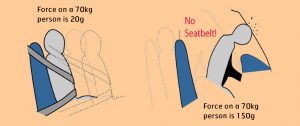
In the picture below, the car travelling at 50km per hour is brought to a stop within 30cm. On the left, the person wearing the seat belt is restrained and pulled back within 50cm as the seatbelt effectively holds back several tons of force at the point of impact. On the right, the person continues to travel at 50km/h until they collide with the steering wheel and windscreen.

Depending on the speeds involved, you may still sustain injuries even though you are wearing a seat belt. However, you will live to tell the tale. Not wearing a seat belt can result in severe head and spinal injuries, as well as being flung from the car, causing even more damage such as paralysis or even death.

The seat belt plays a major role in the safety system of a motor vehicle, but it is also designed to work in concert with the rest of the system such as the head rests, airbags, impact absorption areas etc. To ensure maximum protection from the system, you need to:

  1. Sit square in the seat
  2. Put your feet on the floor of the car – don’t cross them or put them on the dashboard
  3. Strap the belt laterally across your waist, and diagonally down from your shoulder to the buckle
  4. Ensure the head rest is at the right height for you head

Keep your drivers safer on the roads with Retriever’s driver behaviour management functionality. Part of our Fleet Management system, this function will let you know which of your drivers are wearing their seat belts and allow you to implement measures to change driver behaviour for the good. Contact us today for more information.