5 Ways to Improve On-Time Delivery Rates and Otif

With increasing demand from the consumer sector, the pressure on business fleets in the logistics or supply-chain industry has also intensified. This is simply because consumers have more expectations of retailers, and the outturn is that retailers have even higher expectations of your fleet’s delivery performance. 

Let’s show you how to enhance your fleet management with Cartrack delivery to ensure on-time deliveries in full every time.

In this article, you will:

  • Understand the challenge of ensuring on-time deliveries every time
  • Learn 5 ways to improve on-time delivery rates and OTIF
  • Discover the benefits of using Cartrack’s fleet management system and delivery tool to ensure OTIF deliveries
  • Get industry-specific guidance on improving on-time delivery.

On-Time Delivery Rates and OTIF explained

On-time delivery rates and On-Time in Full (OTIF) are popular metrics that manufacturers and retailers use to measure delivery performance within their supply chain and rate their logistics and vendor partners.

With increasing consumer demand due to e-commerce businesses, online food and grocery delivery or even just the variety of products consumers expect from retailers; transportation and logistics companies cannot afford any more delivery delays. Neither can businesses with in-house fleets that move goods from manufacture or farm to store.

Here are some global stats on consumer demand from Meteor Space that paint a clear picture of consumers’ changing behaviour:

  • 76% of customers confirmed that fast shipping positively influences their shopping experience
    ‍
  • 88% of consumers are more willing to purchase from a store that offers free shipping
    ‍
  • 83% of online shoppers want regular customer support and communication on their order status
    ‍
  • 95% of online shoppers expect all shipping issues to be resolved while in transit
    ‍
  • 62% of online US customers believe fast delivery is the most important aspect of customer experience.
    ‍

The online commerce industry in Kenya has also experienced a rapid increase since the COVID-19 pandemic and lockdown. It is estimated that by 2029, this market will be valued at $1.06 billion as online food delivery, clothing, and other retail shopping have dramatically surged.

According to Statista and other sources:

  • Over 40% of Kenyan shoppers want home deliveries for their purchases.
    ‍
  • Over 22% of online consumers consider clear communication on expected delivery timing to be a key factor in a digital shopping experience’s quality (or lack thereof).
    ‍
  • 17% of customers will abandon a brand because of long delivery waiting times.
    ‍

Meeting consumers’ new delivery demands means more businesses in transportation and logistics, and businesses with a complete in-company supply chain must adjust and focus on delivery time demands. That’s why on-time delivery rates and OTIF are critical; let’s tell you more about how they work.

On-time delivery rate

The on-time delivery rate, first and foremost, calculates a business’s ability to meet customer expectations for delivery time. It is used by e-commerce businesses and retailers in last-mile delivery to determine how fast they are meeting customer orders.

38% of online retailers are concerned about meeting these quick delivery expectations from customers at the low shipping costs their customers expect. Businesses can also use the on-time delivery rate to calculate and evaluate their transportation and delivery service partners when they outsource this service. 

On-time in full delivery

OTIF generally refers to a supplier’s ability to deliver the full quantities ordered within the prescribed or agreed-upon delivery time. Suppliers and distributors often face challenges that disrupt timely delivery, such as vehicle breakdowns, traffic congestion or, in Kenya, public protests and demonstrations. Our unique challenge with load shedding can also cause delays and disrupt deliveries. 

There are no standard OTIF expectations; therefore, the methods to improve your company’s delivery rate or quality depend more than anything on the steps you take to improve your fleet’s delivery performance. 

More businesses are seeking customer-level experience from their logistics service partners. This means that they expect better communication from suppliers and distributors, delivery visibility to clients and precise delivery time communication.

Focusing on improving OTIF can help secure customers and enhance your transportation and logistics company’s reputation.

The stakes are high for your delivery fleet’s performance, and unfortunately, improving your on-time delivery rate and OTIF is not always an easy task because it relies on effective collaboration between fleet managers and drivers.  Other external factors such as products being out of stock, warehouse and carrier issues, fuel price increases, protests, demonstrations, and staff shortages, all disrupt the process. Ultimately, problems at any stage in the delivery link can cause delays.
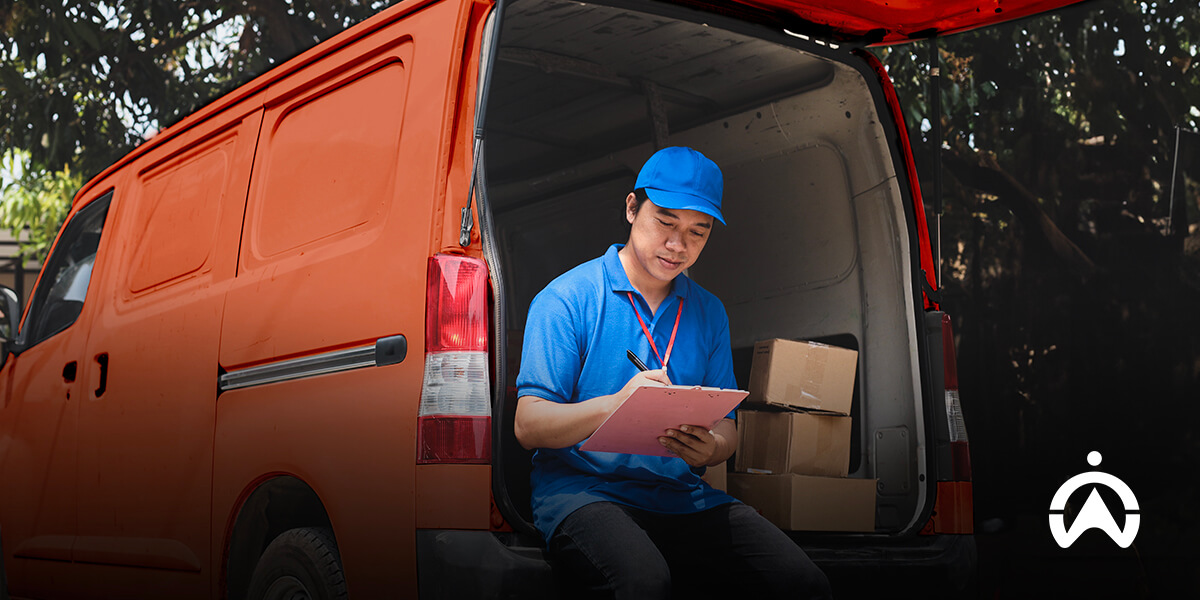
5 ways to improve on-time delivery rates and OTIF

On-time in full (OTIF) is the standard all logistics providers should strive for. Here are some smart strategic ways to improve your fleet’s delivery performance. We’ll guide you on how to apply these steps with real Cartrack case studies based on a carrier company we worked with and helped achieve improved delivery rates.

1. Gain real-time fleet and driver visibility with GPS tracking

Fleet tracking and driver monitoring are critical parts of fleet delivery performance and can help you achieve and improve your on-time deliveries. When fleet managers lack visibility on their fleet, they struggle to monitor drivers’ productivity, see which drivers are available for a delivery task, identify causes of delivery delays, and calculate their on-time delivery rate.

Consider a company like The Courier Guy—a leading South African courier services company that started in 2000. They have over 2,200 fleet vehicles and, with increasing consumer demand, are set to expand their fleet even more over time. With the growing number of drivers, customers and vehicles, it can be challenging for any courier company to manage every part of their fleet. 

Whether you have a fleet of 20 vehicles or over 2,000 vehicles like The Courier Guy, having real-time fleet and driver visibility is one of the best ways to improve your deliveries. 

Cartrack’s telematics and easy-to-use fleet management platform provide The Courier Guy with real-time fleet visibility and driver monitoring that helps them eliminate time-wasting and ensure packages arrive safely and correctly at their customers’ doorsteps.

By addressing the lack of fleet visibility, fleet managers can:

  • Accurately track each vehicle’s location: Gain a complete map overview of all your fleet vehicles and drivers to understand their activity.
    ‍
  • Monitor driver’s productivity: Improve driver accountability and productivity by monitoring their activity on the road. Decrease unnecessary route deviations and stops.
    ‍
  • Receive vehicle trip history reports: calculate their on-time delivery rate: By understanding your current delivery performance, you can easily implement these strategies to improve your delivery rate.
    ‍

Real-time visibility makes it easy for fleet managers to intervene whenever necessary and proactively prevent late deliveries, ensuring a high on-time delivery rate. Immediately addressing and communicating the causes of delivery delays can help improve customer satisfaction and your business services’ reputation, but to do this, you need to make real-time visibility your new best friend.

2. Improve scheduling with delivery fleet management tools

The current shortage of drivers and the lack of capacity for deliveries in your fleet make it difficult for you to improve on-time delivery rates. In line with tracking fleet vehicles and drivers, planning and scheduling the two; adds to the difficulty of ensuring you meet your delivery date. Without the right delivery tools, fleet managers can run into scheduling challenges like:

  • Improperly matching special delivery loads with unqualified drivers or unequipped vehicles.
    ‍
  • Manually logging and scheduling deliveries including recurring orders.
    ‍
  • Unclear estimated time of arrival (ETA).
    ‍
  • Inability to make changes to a delivery or communicate changes.
    ‍

Whether your fleet is inbound, moving deliveries between your facilities and individual stores, or outbound, delivering to customers at their homes, you need to get on top of your scheduling and delivery planning to ensure your packages arrive on time. The good news is that Cartrack’s delivery tool helps fleet companies like yours to optimise scheduling.

  • Easily assign tasks and jobs: With a complete view of driver and vehicle availability, managers can see the progress of the driver’s delivery schedule, easily assign new jobs and ensure the right vehicle and driver is allocated for the job.
    ‍
  • Prioritise and make changes: Your managers can quickly track drivers without disrupting their deliveries and tasks. If a task changes, managers can also instantly tweak the delivery schedule.
    ‍
  • Automate recurring deliveries/tasks: Avoid the repeated manual uploading of customer information or re-inputting of delivery location by automating recurring deliveries.
    ‍

For The Courier Guy, Cartrack’s Delivery software has been an essential part of their fleet operations, simplifying task management and helping ensure customer satisfaction with on-time deliveries. The software automatically enters customer details for recurring orders, helping them reduce manual processes and improve manager-driver communication, which has resulted in faster delivery turnaround times. 

Customers also receive convenient delivery updates with automated emails and SMS notifications.

3. Ensure cargo security and quality with technology

To secure the “In-Full” part of OTIF, businesses can embrace the latest technology like AI cameras to detect and address any cargo theft and sensor technology to ensure products arrive in full without damage. 

The Courier Guy, for example, has improved safety, security and accountability within its fleet thanks to Cartrack’s AI-powered camera live-streaming technology. These digital eyes live-track your cargo and drivers, monitoring driver behaviour and audibly alerting drivers in real time to quickly rectify dangerous behaviour like fatigue or cellphone use. These detection abilities and automatic alerts help result in fewer damaged goods and speeding fines and support stronger brand reputability.  

Cargo theft and product damage in transit are major risks for businesses and can affect their delivery rate, customer retention, and OTIF delivery performance. To prevent these risks, Cartrack’s AI camera tech is ideal for levelling up fleet security.

  • Cargo details and specifications: Managers can upload package information with specifications, and drivers can scan the barcode of goods they load and offload so every piece of cargo is accounted for, safely transported and delivered.
    ‍
  • Cargo monitoring using sensors: With cargo door sensors, managers receive live alerts for unauthorised cargo access. Temperature sensors allow managers to address unwanted temperature changes that could damage products.
    ‍
  • AI cameras for security: Businesses can livestream or download camera footage when they receive alerts of potential cargo tampering and proactively respond.
    ‍

4. Improve driver productivity and efficiency

Driver inefficiencies are a major hold-up for logistics and transportation companies that makes it difficult for businesses to achieve faster deliveries. Empower your drivers with better safety training and improved communication with fleet controllers. 

To improve driver productivity and efficiency, fleet managers need to focus on driver management and set standards for evaluating their performance. A good driver management strategy involves the following:

  • Focusing on driver safety.
    ‍
  • Improving driver performance with work optimisation tools like timesheets.
    ‍
  • Implementing regular vehicle maintenance and inspection routines.
    ‍
  • Equipping drivers with the right vehicle and tools to complete a delivery.
    ‍
  • Hiring and retaining good drivers.
    ‍
  • Introducing policies to ensure legal compliance.
    ‍

Training and incentives: Use driver behaviour reports to train drivers on safer driving practices or incentivise responsible driving based on our driver scorecard that rates your drivers’ performance. Drivers can timeously complete deliveries while ensuring they are committed to safety.

Improve communication with drivers: Reduce driver stress with the Cartrack Delivery app where drivers can access their daily schedule, accept new jobs when available, and get instant alerts for new delivery tasks or changes to existing ones. 

Route planning or route optimisation: Easily plan your driver’s delivery route with route planning, and ensure deliveries are completed promptly by automatically getting the best order for completing deliveries with route optimisation.

Securing a good delivery time rate can only be achieved through your driver’s skilled efforts. Encourage and take care of your delivery drivers so they have a more positive attitude towards their work.

5. Reduce transportation costs and time

Reducing fleet costs is the number one goal for most fleet companies, but it’s actually another way of securing repeat business. Retailers and other companies looking for logistics and transportation service providers also want to reduce their transportation costs to increase their profits. 

According to a 2023 survey, profits can almost double if supply chain expenses fall from 9% to 4%, which is why most businesses aim to reduce their expenses. To do this, most retailers will make a large order for a single delivery. This is the time for your fleet company to shine. If you can ensure that your fleet timely and cost-efficiently delivers on its promise, you can improve your on-time delivery rate.

Load consolidation is a tactical way to reduce fleet costs while improving customer delivery time and efficiency, but it requires effective route planning and scheduling. 

If your business is facing the challenge of balancing cost reduction and timely deliveries to meet customers’ demands; then it may be time to consider making changes to your fleet management that will improve your delivery performance in the future and get your repeat business from customers. Employing Cartrack’s fleet management and delivery tool can enable you to achieve this.

Here are some steps you can take to set yourself apart from your competitors:

  • Invest in your vehicles: Consider buying more fuel-efficient, reliable vehicles to help you avoid any vehicle downtime in your fleet that could cause delivery delays. Alternatively, using preventative maintenance for your fleet scheduling is another way of getting your fleet to run smoothly.
    ‍
  • Address fuel consumption and expenses: You never want your fleet’s running costs to be more than your profits. Reducing fuel costs can help you ensure an ROI from your delivery.
    ‍

These five strategies are intelligent ways to improve your on-time delivery rate or OTIF. Although these measures are based on your customer’s experience with your services and there is no standard for measuring this, these strategies aim to help you improve your service providing to improve your on-time delivery rate ultimately.

Make on-time and in-full deliveries every time with Cartrack

Our fleet management system equipped with Cartrack Delivery helps fleet companies and businesses with in-house fleets keep up with an ever-increasing demand to exceed customer expectations every time.

‍Schedule a demo with us to see how we make delivery magic happen.

On-time delivery rates and OTIF: Frequently asked questions

On-time delivery makes the supply chain go round. Our handy FAQ section answers the most common questions about OTD and OTIF.

How can I improve my OTIF performance?

Here are quick steps to get started on improving your OTIF performance.

Step 1: Increase fleet visibility with GPS tracking and telematics fleet management.

Step 2: Improve driver management and productivity.

Step 3: Use delivery fleet management software and tools.

Step 4: Secure your fleet cargo from theft, loss, and damage.

Step 5: Improve communication from the manager to the driver and right to the customer with updates on the delivery progress.

How do you improve on-time delivery in the last mile?

To improve last-mile delivery time, you can:

  • Set up convenient delivery methods and time for customers.
    ‍
  • Give customer updates on delivery progress.
    ‍
  • Use an all-in-one platform to manage deliveries, such as Cartrack delivery.
    ‍
  • Explore alternative delivery vehicles, such as bikes for smaller packages.
    ‍
  • Use GPS tracking and telematics to understand what’s causing delivery delays and make data-driven decisions.
    ‍

What is the difference between OTIF and on-time delivery?

The on-time delivery rate is used by businesses (especially e-commerce businesses) to measure how many customer orders they’ve fulfilled by the expected delivery rate. Whereas, OTIF is a measure used by retailers and manufacturers to rate transportation and logistics service delivery businesses’ ability to deliver supplies or stock within the agreed-upon delivery time. It also assesses the condition of the delivery, for example, was the order only partially fulfilled, whether some products were damaged in transit, and whether there were missing items.

What is a good OTIF score?

OTIF depends on your customer’s set expectations and satisfaction, but there are different standards for delivery rates and hence different ideas for what counts as a good score.

A good OTIF score would be:

  • 95-99% for A-line products (these are your customer’s bestsellers that represent 50-80% of your sales)
    ‍
  • 85-99% for B-line products (mid-range products that represent 30% of your income)
    ‍
  • 99-100% C-line products (the last 60-70% of products that make only 10-30% of revenue)
    ‍

How do you ensure that all deliveries are made on time?

Several challenges could disrupt your delivery progress, but that does not mean you should take a back seat from improving your fleet delivery performance. Here are some ways that help you keep your delivery promise:

  • Effective Planning with allowance for common delays such as traffic or weather conditions
    ‍
  • Using reliable GPS tracking, fleet management software and delivery tools from Cartrack
    ‍
  • Improve the operations of your entire fleet by reducing costs, focusing on improving driver performance and productivity, automating tasks like route planning managers, and using preventive maintenance to avoid vehicle breakdown.
    ‍

This is what our partner companies love about us:

“Cartrack’s technology allows us to focus on our drivers, customers, cargo, and fleet all from one platform. It puts us in control from dispatch to delivery.”

Jeffrey Wheeler, Assistant Fleet Manager, Courier Guy, South Africa.

Contact us for more information about time-tested and advanced fleet management solutions.
Powerful Fleet Management Reporting: 7 Ways to Simplify Your Fleet Company

There’s nothing better for fleet managers than improved driver productivity and safety, increased fuel efficiency, and more savings.

But how can your fleet manager achieve this for your fleet company without the right tools? 

Fleet management systems like Cartrack’s offer advanced yet easy-to-use tools for your fleet company, helping your fleet managers use powerful fleet management reporting to address fleet-related pain points head-on. 

In this article, you will:

  • Get seven ways to simplify your fleet company
  • Understand the power of fleet management reporting to simplify your fleet management
  • Learn how to effectively use reports and big data to address key fleet challenges
  • Discover ways to simplify your fleet using reports from Cartrack

Fleet management systems are designed and equipped with tools that simplify your fleet company, whether your business leases out a commercial fleet to customers, is in the transportation industry, or has a fleet of delivery vehicles hitting the road every day.  

7 ways to simplify your fleet company with fleet management reports

You may have once believed that simply installing a GPS tracker to your fleet would instantly help you improve your fleet company. While we’re here to confirm this belief, just with a twist. GPS fleet management is the key to simplifying your fleet company.

A recent survey found that 60% of business owners with a GPS fleet management system had not unlocked the full potential of a fleet management system. 

Managing a fleet is not an easy task, no matter the fleet size or industry. Here are seven ways you can start smarter and simpler fleet management with customised reports that help you get more bang for your buck in terms of safety, productivity, and profits. 

1. Keep track of every vehicle and asset in your fleet

It gets difficult to confirm how your drivers and clients are handling your assets when your vehicles are out on the road, or your machinery is stationed at a remote worksite. Managing your fleet can get even more complicated depending on the number of fleet vehicles you have and the mix of your different assets.

The primary advantage of tracking your fleet is that you can prevent the theft and misuse of your valuable assets or simply gain insights into the productivity of your fleet. With a GPS fleet management system like Cartrack’s, you can simplify your fleet company by:

  • Using live GPS tracking: With a GPS tracker, you can always know where your fleet vehicles and assets are. Fleet managers can also get real-time updates on their vehicles so they can address issues such as whether drivers are using them outside work hours.
    ‍
  • Setting geofence zones: Set virtual boundaries around specific locations to get alerted when your vehicles enter or exit the area. For example, you will get alerted if any of your heavy machinery is removed from one of your construction sites and used at an unauthorised location.
    ‍

Analysing vehicle trip history reports to increase driver productivity

You can see the start and end locations for all your vehicles and understand past vehicle activities. This is a great way to identify fraudulent activity with your vehicles, or you can simply create a logbook to separate business trips from private trips on your vehicles.

Understanding your vehicles or assets is one of the most straightforward ways to identify your fleet’s shortfalls.

 2. Monitor your driver’s behaviour and performance

Your fleet’s profitability, productivity, and safety highly rely on your drivers. If your driver is not meeting service standards, this can turn customers away and affect your profits, similarly, if your drivers are undercutting their work hours or making personal runs during deliveries, they can affect productivity.

Safety is also important, and reckless driving can cause fatal accidents that cost lives and damage your vehicles. Fortunately, our fleet management system makes the work of monitoring drivers easy with a collection of driver behaviour and performance tools such as:

  • GPS tracking and telematics: This single tool also helps fleet managers monitor how drivers use fleet vehicles. Fleet managers get reports on harsh driving events such as speeding, harsh braking and excessive idling. Monitoring these types of behaviour helps managers understand their drivers’ bad habits and use insights to correct bad driving and train drivers on safety.
    ‍
  • Driver identification tags: Prevent unauthorised vehicle and machinery usage with driver ID tags assigned to each of your drivers. This way, fleet managers can know which drivers have used their fleet and improve accountability.
    ‍

Driver scorecards: The perfect driver behaviour reporting tool

See how your drivers score in terms of good versus bad driving habits and incentivise drivers based on their scores. This is an excellent way for fleet managers to recognise drivers.

3. Use purchasing controls for fuel

Track your fleet’s fuel consumption, tackle high fuel expenses, and prevent fuel theft in your fleet by introducing fuel purchasing and efficiency controls. Fuel theft is a growing concern in Kenya, so if you have been suspecting fuel theft in your fleet or you’re concerned about the sudden increase in your fleet’s fuel expenses, there are solutions for your fleet.

Cartrack’s fuel management system uses three primary tools to help you control fleet fuel costs, these include:

  • Fuel sensors: Measure the amount of fuel in your vehicle or machinery’s tank using sensors. This information helps managers monitor their fleets’ fuel consumption per period which is helpful for budgeting and fuel claim validation.
    ‍
  • Fuel cards: Drivers and other staff can use business fuel cards for refuelling vehicles and machinery or paying for vehicle servicing. Fuel cards help reduce the administrative work of tracking your fleet fuel costs but also quickly identify fuel theft and other issues.
    ‍

Keep track of that liquid gold with fuel consumption reports

Fleet fuel reports are an effective way to monitor your fleet’s fuel consumption and track your expenses. You can customise and automate fuel reports that will help you quickly identify fuel theft or inefficiencies.

4. Save with preventative maintenance

Establishing a maintenance schedule to effectively minimise vehicle downtime and extend your fleet’s lifespan, completely reversing your fleet company. Instead of attending to vehicles and machinery once they have broken down, your fleet staff can get proactive about maintenance to avoid these issues and costly repairs.

Now fleet managers can simplify fleet maintenance and save on their fleet with Cartrack solutions for maintenance that include:

  • Maintenance reminders: Our preventative maintenance software lets you schedule maintenance and services according to your fleet’s needs to ensure uninterrupted workflow. Now fleet staff know when and why a vehicle or machinery is not available.
    ‍

Increase your fleet’s longevity with vehicle health reports

Get detailed, customised reports on your vehicle and machinery’s health and see the history of the asset’s condition. For example, battery health and engine performance. This report helps your fleet managers stay informed on your asset’s condition and identify issues that need servicing or repairs faster.

Use maintenance reports for fleet health and reduced downtime

Maintenance reports provide a summary of your vehicle history, so your fleet staff can plan for any vehicle downtime or use these reports to assess whether they should replace certain vehicles or equipment.

5. Prioritise safety and compliance

According to a 2023 survey for fleet managers, 48% of fleet owners identified fleet safety and regulatory compliance as their number one priority. Regulations for fleet compliance are constantly changing and updating, so this has become a big challenge for fleet managers globally.

Fleet companies must comply with several safety regulations that are constantly changing to ensure the safety of drivers and vehicles when they are on the road. Our fleet management system helps simplify fleet compliance with:

  • Safety training: Conduct thorough onboard training for new drivers and keep training older drivers on safe driving. Fleet managers can use driver behaviour reports to train drivers on safer driving practices.
    ‍
  • Record keeping: Store important driver and vehicle information on our cloud-based fleet software so that all your fleet staff and stakeholders can access the documents from anywhere. Fleet managers can also set reminders to renew vehicle licenses or complete fines and toll payments.
    ‍

Keep your drivers safe on the road with driver inspection reports

Fleet managers can ensure drivers are prepared for every trip with a pre-trip inspection. For example, you can require drivers to check whether a fire extinguisher is available before any trip.

6. Use tasking and scheduling software

With Cartrack Delivery, assigning delivery tasks, field service work or emergency service calls to drivers and mobile workers has been simplified. Fleet managers can easily coordinate deliveries, tasks, and fleet vehicles so your fleet company stops losing out on profits.

No matter what industry you are in, food and beverage, logistics or e-commerce, our delivery tool disentangles the process. Fleet managers can use Cartrack delivery for:

  • Task management: Fleet managers can easily update delivery/field task information and quickly match drivers with available fleets. The process is instant, and any updates are instantly communicated with your drivers, so there are no delays or miscommunication.
    ‍
  • Route planning: Managers can quickly track drivers without disrupting their deliveries and tasks. If there are changes to a task, managers can also instantly change the schedule for delivery or services via the Cartrack Web Page or the mobile app.
    ‍
  • Communicate with drivers and customers: Use Cartrack delivery to ensure an open line of communication between fleet managers, drivers, and customers. These tools help drivers communicate delays directly with customers and managers.
    ‍
    ‍

7. Manage and reduce your fleet overhead expenses

Track, analyse, and control all the expenses associated with your fleet of vehicles, heavy machinery, and assets. Fleet overhead expenses refer to the indirect costs associated with your fleet. These costs can easily go undetected, such as vehicle taxes or renewing licensing fees. Managing these types of expenses is important for budgeting and seeing the return on your fleet investment.

With Cartrack’s MiFleet, you can ensure your fleet expenses don’t get out of control. MiFleet is a cost and accounting management software that tracks all the expenditures related to your fleet company, see how fleet managers easily access and use MiFleet to manage such expenses:

  • Budgeting: Reduce your fleet’s overhead expenses by tracking the expenses over time and identifying areas where your fleet could save money.
    ‍

Gain full financial control of your business with driver and asset reports

Receive reports on all costs associated with your vehicles, drivers, and assets. Now, fleet managers can get a breakdown report to understand the profitability and ROI of their fleet investment.

Take advantage of automated MiFleet reports for smart budgeting

These customisable reports can be automated for fleet managers to access monthly or every other quarter so they can understand their fleet’s expenses and budget appropriately for the next quarter.

Fleet management reporting is a smart, strategic, and powerful way to improve your fleet company.

Access Powerful Fleet Management Reporting with Cartrack

Cartrack’s fleet management system digitises, compiles, and organises various fleet reports, so you don’t have to deal with 500 computer tabs, over-complicated spreadsheets or incompatible fleet software.

Contact us to find out more about fleet management reporting for your unique fleet company.

The Most Dangerous Countries in the World

While there are beautiful places in the world, some countries have made their way to the list of the top 10 most dangerous countries in the world. Based on the latest research this blog will show you just which countries are the most dangerous. 

We’ve also compiled a list of the most dangerous countries by region based on the likelihood of robberies, thefts, hijackings and other crimes. So whether you are planning a holiday for your family or researching potential business risks globally, this list will pique your interest. 

Bonus: 5 Cartrack tips for protecting your loved ones and assets in a ‘dangerous country’.

In this article, you will:

  • Get a list of the top 10 most dangerous countries in the world
  • Understand what makes these 10 countries dangerous
  • Get a list of the most dangerous countries by region
  • Have a look at South Africa and understand the dangers here in a country case study
  • Explore the top 5 Cartrack tips for individuals and businessesin South Africa
  • Get answers to FAQs

‍Top 10 most dangerous countries in the world

The World Population Review lists the following countries as the most dangerous based on their crime rate results (from worst to least):

This crime rate is based on the number of crimes reported per 100,000 people. To calculate the crime rate, the World Population Review divide the number of crimes of any type by the total population of the country and multiplies this by 100,000 people.

But what exactly makes each of these countries dangerous? 

  1. Venezuela‍

The number one contributor to the high crime rate in this South American country is government corruption, the poor justice system and sentencing for crimes and the lack of respect for the rule of law. The crime index in this country is 83.76 which is the highest of any country in the world. 

  1. Papua New Guinea 

This country is known for being one of the most diverse countries in the world, with residents speaking over 800 different languages. Unfortunately, it’s also known for violent crimes fueled by rapidly changing political, economic and social changes in the country, the corruption and gang-related activity in the country. Bringing this diverse country to the second most dangerous country in the world. 

  1. Afghanistan

Over the years, this country has been known for its constant political instability and conflict in the area, which all contribute to its high ranking. Afghanistan suffers from various crimes that include corruption, kidnapping, money laundering and other crimes such as robbery and assault. 

  1. Haiti

The Caribbean country of Haiti has struggled with political stability, increasing gang warfare, and economic challenges. The biggest contributor to its high rank is the increasing number of homicides over the years, either from violent conflicts or intergang violence. 

  1. South Africa

With a crime index rate of 75.5, unfortunately, our beautiful rainbow nation makes its appearance as one of the top 5 most dangerous countries. South Africa has a notably high rate of assaults, rape, homicides and other violent crimes, which all contribute to our rank on this list.

  1. Honduras

In 2012, Honduras was reported to have experienced about 20 homicides per day due to gang violence. Today, the country is still inflicted with violent crime caused by gangs, drug trafficking and almost nonexistent law enforcement to control the country’s notorious reputation of lawlessness. 

  1. Trinidad and Tobago

This state faces several challenges caused by increased crime from gangs and drug-related crimes, which the government struggles to address. It takes the 7th spot on this list, and visitors to this country can become victims of pickpocketing, assault, theft and fraud.

  1. Syria

The conflict in Syria has led to increased crime, widespread corruption, and bribery, putting this Middle-Eastern country at 8th place on this list. It’s also become known for violent crimes such as kidnapping, assault, carjackings, and robberies.

  1. Guyana

The Northern South American country is small, sparsely populated, and Anglo-Caribbean. Due to the high murder rate, lack of law enforcement support for domestic violence, and frequency of armed robberies, this country has a high crime rate of 68.74. It ranks 9th on this list. 

  1. Peru

Homicides, corruption, domestic violence, pickpocketing, and petty crimes have landed Peru at the 10th spot on this list of the most dangerous countries. Over the years, the crime rate in Peru has decreased, and with each year, they report decreasing rates of crime.

Are there any countries you were surprised made the list or some countries that did not make the list? 

One thing we’ve noticed about this list is that as much as there are differences in crime rates among these countries, the crimes also vary by severity in each of these countries. This list of the 10 most dangerous countries above is not an entirely reliable guide on places you should not be or should not take your company to but is a useful starting point.

We’ve compiled a list of the most dangerous countries by region based on the likeliness of hijacking, robbery and theft, which are the most common crimes tourists and business travellers experience. 

The most dangerous countries by region

Some of the countries on this list may be a few kilometres away from you, while others require you to cross borders or even take a flight to witness the dangers. 

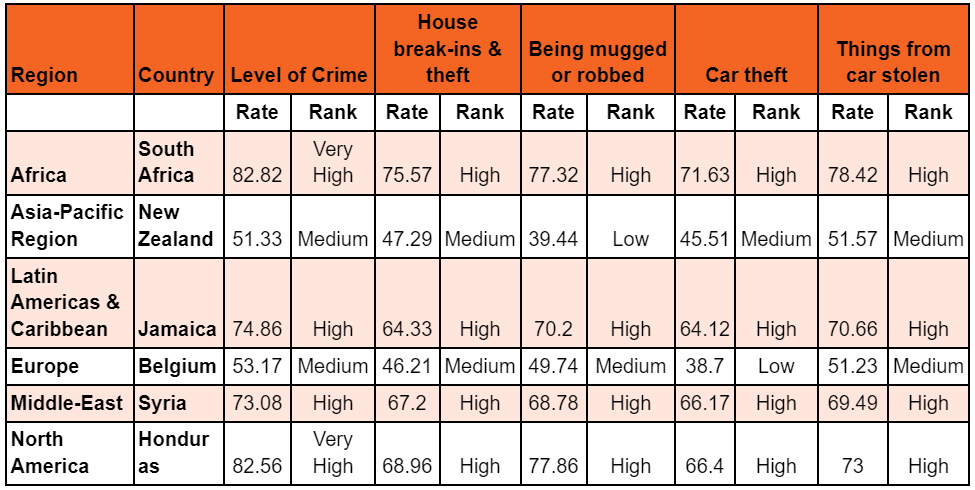
Our selected list of the most dangerous countries in the world is given by region and is based on the likeliness of theft crimes and the fear of theft crimes within the country. We use the Crime Index, and Safety Index from Numbeo as a data source. 

Crime index – an estimate of the crime level in a given city or country. The rate is based on a survey of the general perception of crimes, safety levels, and concern about specific crimes. The rate also considers property crimes and violent crimes in the country. The higher the crime index, the more risk is perceived in the country, and the lower the index, the less crime is perceived and experienced.

Safety index – an estimate of how safe the city or country is, the higher the safety index, the safer a country is perceived to be.

We’ve focused on the level of crime and worries about different crimes, such as house break-ins, robberies, car theft and other thefts in these countries. 

List of countries highest crime and dangerous

South Africa: The most dangerous country in Africa

Crime Index: 75.44

Safety Index: 24.56

South Africa has landed the number one spot for the most dangerous country on the continent based on the likeliness of theft. According to research by MSN News, Cape Town, Port-Elizabeth, Durban, Johannesburg, and Pretoria are the top five most dangerous cities in Africa. This is due to crimes such as theft, house break-ins, petty crimes, carjackings, and smash and grabs.

New Zealand: most dangerous country in Asia-Pacific Region

Crime Index:  47.72

Safety Index: 52.28

The rate of theft stats show that New Zealand reported the most thefts in 2020 among the island countries, and the number of victim-reported thefts increases annually. Petty crimes and theft are the most common types of crime in the country, and in cities like Auckland and Canterbury, vehicle theft has also been particularly high.

Jamaica: most dangerous country in Latin American & Caribbean Countries

Crime Index: 67.57

Safety Index 32.43

Jamaica is often believed to be unsafe because of the high homicide rates. In 2023 this country reported 60,9 murders per 100,000 people. These rates are largely due to gang violence and drug-related crimes. Petty crimes and a lack of police and law enforcement also make the country quite unsafe for tourists and travellers.

Belgium: most dangerous country in Europe

Crime Index: 49.49

Safety Index: 50.51

According to Statista, Latvia has the highest homicide rates, and this has landed Latvia in the first position as the most dangerous country in Europe. But a more recent statistic based on crime theft places Belgium, particularly the capital Brussels, as the city with the highest crime theft rate in Europe. Petty thefts, purse snatching and pickpocketing are the most common crimes in Belgium. In 2021, however, there was an increase in stolen bike and car theft crimes.

Syria: most dangerous country in Middle-East

Crime Index: 68.61

Safety Index: 31.39

This region is known for having the lowest theft crime rates compared to other countries in the world because of strict law enforcement measures and extreme penalties for crime. However, Syria has topped the list of the most dangerous countries in the region.

Honduras: most dangerous country in North America

Crime Index: 73.11

Safety Index: 26.89

Honduras has one of the world’s highest murder rates, making it one of the most dangerous countries. Crime such as armed robberies, carjackings, trafficking, and even bus jackings have also grown as an area of concern in the country. Government crime prevention tactics against gang violence and other organised crime have had little to no impact over the years, making it one of the countries with the lowest safety index.

Country Focus: Understanding the dangers in South Africa

South Africa is one of the most beautiful places in the world but somehow lands on the list of the most dangerous countries in the world. This might not be a shock to many of us, as we have become more fearful of crime in our country. 

According to StatsSA, since 2021, South Africa has witnessed an increase in the number of household crimes such as house break-ins, home robberies, and vehicle theft. For businesses, the sudden increase in the number of cargo thefts and fuel thefts from trucks has also become a concern. The South African Police Services (SAPS) crime stats confirm the increase in these types of crimes.

But what are some things we could do to protect ourselves now that we know we live in one of the most dangerous countries?

Top tips for safe living in South Africa

  1. Secure your home

         There are several services and products you can purchase in South Africa to protect the things you care about. For example, get insurance to protect your devices, such as TVs and cell phones. When your devices are insured   your insurance company will pay out a certain amount to you to help you recover your loss and avoid suffering from a household crime or petty crime.In addition, adding an alarm system or aiming to live in a safer area is   another way to add security to your life.

  1. Secure your vehicle

        Add another level of security to your vehicle insurance. GPS tracking and stolen vehicle recovery (SVR) services from a company like Cartrack can help you get your car back. With carjackings and hijackings increasing every  year, this is the best security you can get for your vehicle. 

  1. Don’t be a target—be vigilant

       Whether you are driving or simply walking down the street, avoid displaying your valuables, such as jewellery, cameras, and mobile phones so you are not the target of petty crime and other theft. Keep your handbag or  backpack while driving or when parked to avoid a smash-and-grab.

‍

Our top tips for doing business in South Africa

Running a fleet company in South Africa may seem a bit more tricky now. Here are two quick tips to secure your fleet in South Africa.

  1. Prevent fuel theft with fuel monitoring solutions

Fuel theft has become a growing concern in South Africa, and more businesses have reported concerns about fuel theft in their fleet. Businesses in transportation, mining, and manufacturing have also revealed decreasing fleet profitability and efficiency due to fuel theft. Cartrack’s fuel monitoring solution is one of the most strategic ways that you can protect your fleet from fuel theft, increasing expenses and other challenges relating to your business.

  1. Safeguard your drivers with GPS tracking 

With GPS tracking and telematics, you can monitor your fleet and other company vehicles to protect drivers while they are out on the road. One of the latest innovations from Cartrack is a panic button for drivers to alert us and managers of any emergency or security issue.

For example, if there is an accident at one of your remote sites, your driver can use the panic button to alert our control room of the incident, and Cartrack can take action immediately. 

Don’t live on the edge safety-wise. Let Cartrack give you peace of mind.

If you live in one of the most dangerous countries in the world, you are constantly worried about your safety.

There is global concern over increasing crime, but Cartrack has been committed to ensuring vehicle safety and fleet security since 2004. 

Contact us here for our innovative tracking solutions.  

5 FAQs worth checking out

Country Crime Rate Safety Index
1 Venezuela 82.1 18.8
2 Papua New Guinea 80.4 20.3
3 Afghanistan 78.4 21.7
4 Haiti 78.3 22.1
5 South Africa 75.5 24.6
6 Honduras 74.3 26.6
7 Trinidad and Tobago 70.8 29.2
8 Syria 69.1 30.9
9 Guyana 68.8 31.4
10 Peru 67.5 31.9

South Africa recently ranked number 5 on the list of most dangerous countries in the world.

South Africa often ranks first on the list of most dangerous countries in Africa.

Afghanistan was rated the most dangerous country in the world based on the conflict, militarisation, political instability, homicide and other factors.

But Papua New Guinea had the highest crime index in 2024.

Andorra, a country in Europe, was reported as the safest country in the world in 2024.

Contact us for the ultimate vehicle tracking and security.