ESG in Your Fleet Management and Understanding Your Carbon Footprint
Published
Reading time
8 minutes
Blog
Key takeaways:
To successfully understand your company’s carbon footprint and implement ESG in your fleet, you need a telematics system
Karooooo has all the hardware and software your business needs to implement ESG in your business
ESG principles need to be woven into the core of a company’s strategy
Preventative maintenance, driver behaviour, route optimisation and fuel management all help to reduce your fleet’s carbon footprint
Implementing ESG in your fleet management strategy and understanding your carbon footprint is incredibly important for fleets in 2026 and beyond. It’s a challenge for businesses to manage their carbon footprint while customer demands rise, and the need to stay ahead of their competitors intensifies.
What are the key ESG metrics for fleet performance reporting?
The key ESG metrics for fleet performance reporting are centred around lowering your environmental impact, improving driver safety, and upholding operational governance. The ESG metrics you should monitor are:
How can I integrate ESG principles into my fleet management strategy?
Integrating ESG principles into your fleet management strategy starts with taking actionable steps like prioritising driver safety, optimising routes, and introducing electric or hybrid vehicles into your fleet. By applying these practices into your daily operations, you’ll ensure the long-term success of your sustainability goals while minimising your fleet’s environmental impact.
Let’s take a deeper look into these principles…
Corporate citizenship in fleet management
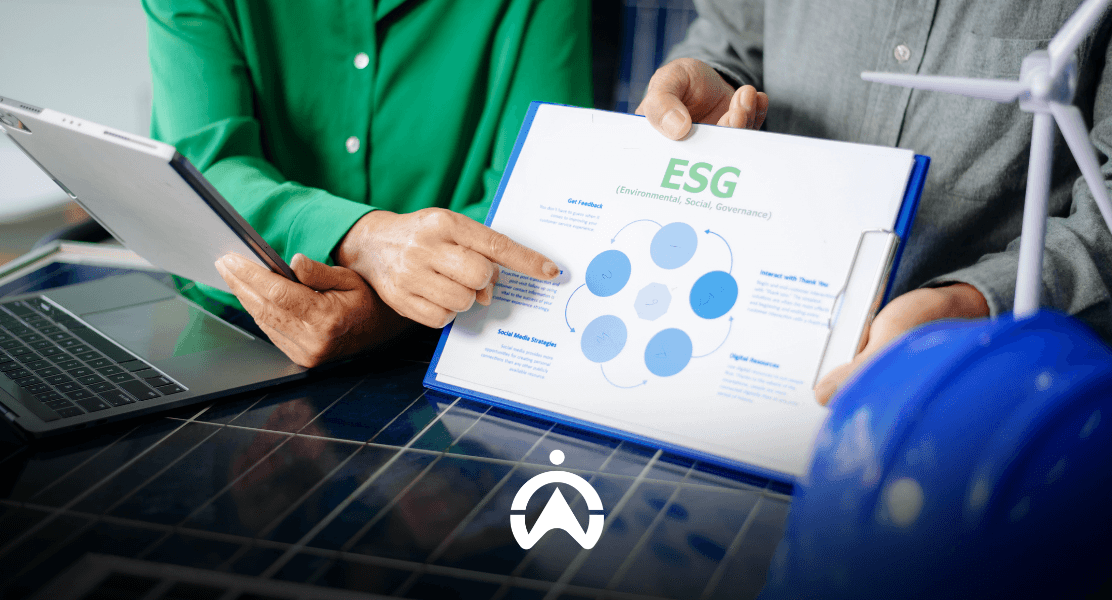
Corporate citizenship is the extent to which businesses are responsible for their actions and impact on their community, the environment and their employees. Environmental, social and governance (ESG) principles need to be embedded into the core of a company’s strategy.
A strong corporate citizenship is what builds a company’s reputation, develops customer and employee loyalty, and can result in an increase in shareholder interest and lower regulatory pressure.
The environmental footprint (the “E” in ESG)
According to research, “the transport sector accounts for approximately 16% of global greenhouse gas emissions… particularly in road transport, which remains the main contributor to these emissions”.
To successfully reduce your environmental footprint, here are some of the things you can implement in your fleet:
Reduce unproductive idling: Unnecessary idling may seem like a small thing, but it plays a major role in your fleet’s carbon footprint. Getting real-time alerts and reports can help you stop this behaviour in its tracks.
Optimise route efficiency:Digitalising route planning allows you to reduce the amount of time your fleet spends on the road and automatically finds them the most efficient routes to travel.
Predictive maintenance: When your vehicles are regularly maintained, you’ll ensure that all your vehicles’ engines are operating at optimal efficiency with effective combustion. Having digital inspection reports and engine diagnostics will simplify this process for your fleet managers, and you’ll ensure your fleet is performing efficiently at all times.
Get the latest tech in your fleets to further your teams’ success—rather than using it to reprimand them. Shift your corporate mindset from blame to empowerment. Here’s how you can start:
Prioritising driver safety: Tech like driver scorecards and AI-powered cameras that can detect high-risk driver behaviour (like speeding or distracted driving) provide real-time, audible, in-cabin alerts so drivers can self-correct.
Promote transparency & trust: Automatic and accurate reporting of working hours lets you guarantee fair compensation and legitimate overtime claims, eliminating any disputes between workers and management.
Regulatory compliance: Digital tools can help you ensure that your drivers aren’t exceeding governed working hours and that mandatory document renewals like licences and maintenance certifications are up-to-date.
Privacy & data protection: You have to make sure that your fleet systems are GDPR compliant and offer “private mode” features for your drivers so that vehicle data during personal time is hidden.
Steps to implement sustainable fleet management practices
Before you start implementing any sustainable and eco-friendly practices into your operations, you have to first accurately assess your current fleet. Find out how much fuel your fleet is currently using, how the engines are currently performing, and what the average mileage of your fleet is.
Introduce alternative vehicles into your fleet
Mixing your fleet with hybrids, electric or hydrogen-fuelled vehicles is an expensive but great way to reduce your carbon footprint. If you’re feeling a bit hesitant to upgrade your entire fleet in Kenya (because infrastructure for these vehicles is still in its preliminary stage), start off with one or two vehicles to test their feasibility.
Implement a telematics system
Installing telematics systems in the entirety of your fleetis the best way to build a sustainable fleet. Telematics will provide you with insights on driver behaviour like speeding, idling and harsh braking, which all burn more fuel and increase your carbon footprint.
GPS tracking and AI-powered software assist with route optimisation so your drivers will use more efficient routes. Subsequently, you’ll consume less fuel and spend less time on the roads.
Telematics also gives insights into how your vehicles are performing. Preventative maintenance tools will ensure your vehicles are performing optimally at all times. Poorly maintained vehicles are less fuel efficient and have a shortened life span, which contributes negatively to your sustainability goals.
Train drivers to drive more eco-friendly
The cheapest way to build a sustainable fleet is by training your drivers to have more eco-friendly driving habits. The way your drivers handle the vehicles on the road directly impacts how much fuel they consume.
Train your drivers to practise driving habits like:
If you have electric vehicles in your fleet, you should install solar-powered charging stations in your depots. When you invest in sustainable infrastructure in your business, you not only guarantee long-term savings; you also significantly reduce your business’ carbon footprint.
Set up a fuel management strategy
The best way to understand and minimise your fleet’s carbon footprint is by setting up a fuel management strategy. Using a combination of hardware and software, you can accurately monitor the fuel usage of each vehicle and machine in your business.
How to calculate my fleet’s carbon footprint accurately?
Accurately calculate your fleet’s carbon footprint with either a mathematical estimation or a telematics measurement. Estimating involves multiplying the total litres of fuel consumed by 2.68kg (diesel) or 2.32kg (petrol). Telematics is more accurate, providing real-time data on fuel consumption, idling and mileage, giving you automated reports that show accurate vehicle performance and monthly emission totals.
How can a fleet reduce its carbon footprint through route optimisation software?
Route optimisation can reduce your fleet’s carbon footprint by minimising your fleet’s fuel consumption on the road. Advanced route optimisation will use real-time data and GPS tech to automatically update your drivers’ routes, finding them the most efficient and shortest route possible.
How can telematics data reduce a fleet’s carbon footprint?
Telematics data can reduce a fleet’s carbon footprint by providing your business with relevant data that measures your sustainability. A telematics system will provide you with insights on driver behaviour, vehicle performance and fuel management insights, which all work to reduce your fleet’s overall carbon footprint.
Other articles for you
Fleet Logistics Management – Boost Your Supply Chain And Fleet Costs
Blog
11 minute read •
The logistics industry is constantly evolving. Is your operation equipped to stay ahead? Fleet logistics is just what the fleet doctor ordered to help you reduce costs, elevate efficiency, and enhance safety in your operation. Read on to discover the world-class solutions available at the tap of a button. What are logistics? The logistics […]
Fleet Fuel Card Integration – Empower Your Fleet With Efficiency and Security
Blog
9 minute read •
When it comes to managing fuel efficiently and reducing costs for your fleet business, fuel credit cards stand out as one of the top solutions. Explore the intricacies of these cards and discover how they can ease all your fuel expense-tracking headaches. Is it time to invest in some fuel cards? All your answers are […]
Truck Fleet Management – Here Is The Ultimate Guide For Your Fleet
Blog
17 minute read •
Managing a fleet of trucks, whether it’s a couple of vehicles or a couple of hundred, comes with a distinct share of challenges. These challenges can stand in the way of your entire fleet’s efficiency, increasing operational costs, and lowering vehicle lifespan, amongst many others. That’s why a good fleet management system is the key […]
 South Africa
 Botswana
 Malawi
 Mozambique
 Namibia
 Nigeria
 Swaziland
 Tanzania
 Zimbabwe
 Hong Kong
 Indonesia
 Singapore
 Malaysia
 Philippines
 Thailand
 New Zealand
 Vietnam
 Poland
 Portugal
 Spain
 United Arab Emirates