THE DECISION THAT CHANGED THE FUTURE OF AUTOMOTIVE SAFETY
Published
Reading time
3 minutes
Blog
60 years ago, Swedish motor manufacturers, Volvo, made a decision that would revolutionise safety in a motor vehicle, from cars to trucks and busses; they shared the patent for the 3-point seat belt and in so doing saved an incalculable number of lives.
The “seat belt” had been around for several years, with the first American patent coming out in 1885 involving “hooks and other attachments for securing a person to a fixed object.” There was even a child seat back in the day, a sack with a drawstring attached.
Through the years, as our understanding of the forces and dynamics involved in driving, and indeed in the sudden stops that often occur, so our need for better safety features became apparent. However, while pilots and racing drivers were strapped into harnesses, civilian drivers had to, for the most part, use a lap restraint, a device which did more harm than good in a car accident.
Then in 1959, Volvo engineer, Nihls Bohlin, invented a mechanism that would go on to become the most successful contribution to safety in the history of motoring and Volvo declared that the “life-saving three-point seat belt was too significant not to share. They opened the patent to all recognising Bohlin’s invention as a free life-saving tool rather than something to profit from.
A former aviation engineer, Bohlin understood what was needed – a system that would effectively absorb the force across the body, yet be simple enough for a child to use. The innovative V-design, with the anchors at the lowest point of the triangle meant the belt would stay in place and not shift under the load.
How a 3-point seat belt can save your life
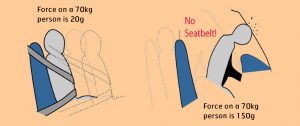
In the picture below, the car travelling at 50km per hour is brought to a stop within 30cm. On the left, the person wearing the seat belt is restrained and pulled back within 50cm as the seatbelt effectively holds back several tons of force at the point of impact. On the right, the person continues to travel at 50km/h until they collide with the steering wheel and windscreen.
Depending on the speeds involved, you may still sustain injuries even though you are wearing a seat belt. However, you will live to tell the tale. Not wearing a seat belt can result in severe head and spinal injuries, as well as being flung from the car, causing even more damage such as paralysis or even death.
The seat belt plays a major role in the safety system of a motor vehicle, but it is also designed to work in concert with the rest of the system such as the head rests, airbags, impact absorption areas etc. To ensure maximum protection from the system, you need to:
Sit square in the seat
Put your feet on the floor of the car – don’t cross them or put them on the dashboard
Strap the belt laterally across your waist, and diagonally down from your shoulder to the buckle
Ensure the head rest is at the right height for you head
Keep your drivers safer on the roads with Retriever’s driver behaviour management functionality. Part of our Fleet Management system, this function will let you know which of your drivers are wearing their seat belts and allow you to implement measures to change driver behaviour for the good. Contact us today for more information.
Other articles for you
Fleet Logistics Management – Boost Your Supply Chain And Fleet Costs
Blog
11 minute read •
The logistics industry is constantly evolving. Is your operation equipped to stay ahead? Fleet logistics is just what the fleet doctor ordered to help you reduce costs, elevate efficiency, and enhance safety in your operation. Read on to discover the world-class solutions available at the tap of a button. What are logistics? The logistics […]
Fleet Fuel Card Integration – Empower Your Fleet With Efficiency and Security
Blog
9 minute read •
When it comes to managing fuel efficiently and reducing costs for your fleet business, fuel credit cards stand out as one of the top solutions. Explore the intricacies of these cards and discover how they can ease all your fuel expense-tracking headaches. Is it time to invest in some fuel cards? All your answers are […]
Truck Fleet Management – Here Is The Ultimate Guide For Your Fleet
Blog
17 minute read •
Managing a fleet of trucks, whether it’s a couple of vehicles or a couple of hundred, comes with a distinct share of challenges. These challenges can stand in the way of your entire fleet’s efficiency, increasing operational costs, and lowering vehicle lifespan, amongst many others. That’s why a good fleet management system is the key […]
 South Africa
 Botswana
 Malawi
 Mozambique
 Namibia
 Nigeria
 Swaziland
 Tanzania
 Zimbabwe
 Hong Kong
 Indonesia
 Singapore
 Malaysia
 Philippines
 Thailand
 New Zealand
 Vietnam
 Poland
 Portugal
 Spain
 United Arab Emirates